



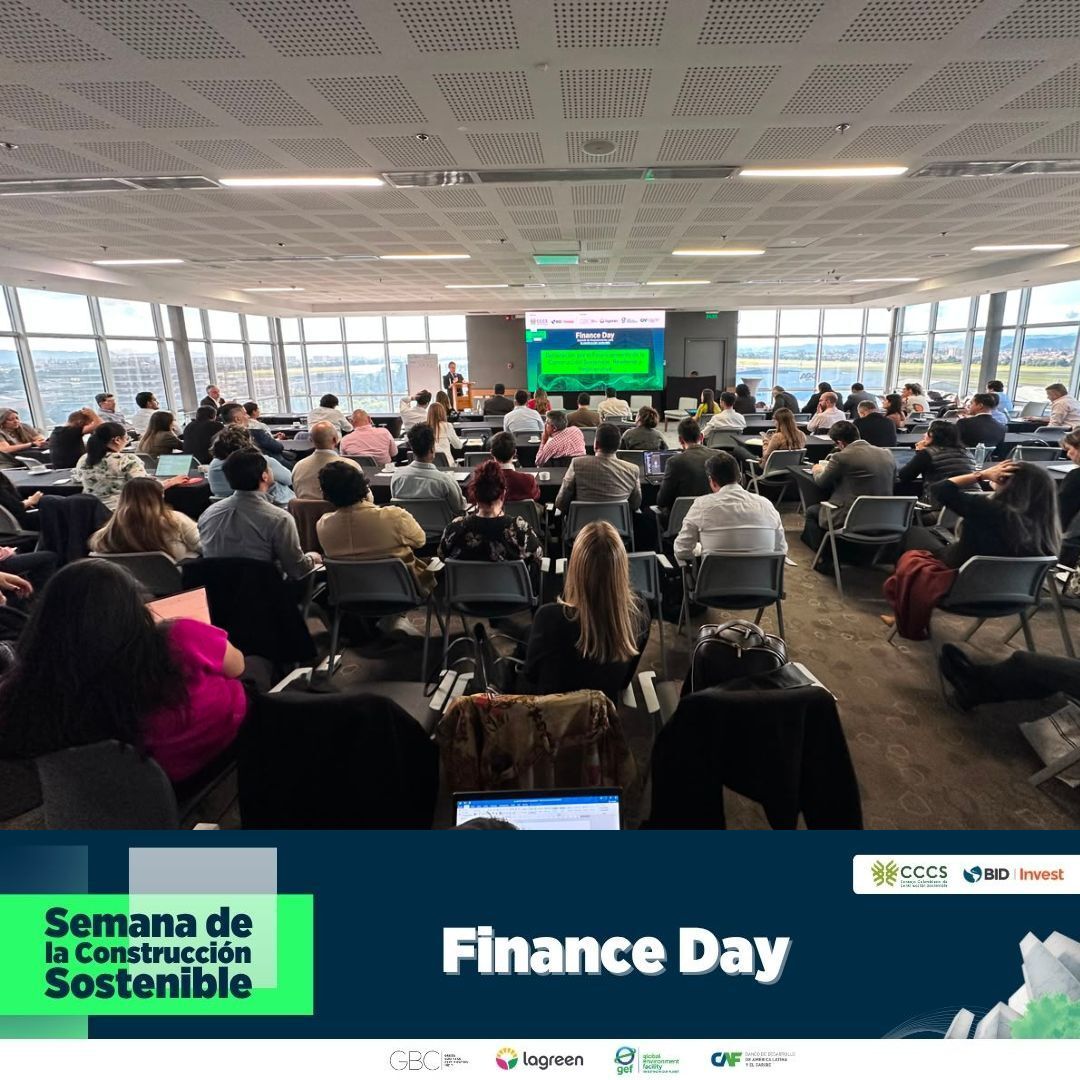
Representatives from the financial, insurance, construction, investment, and multilateral sectors gathered in Bogotá, Colombia to advance mechanisms that strengthen risk management, improve project bankability, and expand sustainable investment across Latin America.
As part of the Sustainable Construction Week, the Colombia Green Building Council (Colombia GBC) and BID Invest hosted the Finance Day: Sustainable Construction Finance Summit 2026, a regional event designed to connect the financial sector with developers, insurers, investors, multilateral development banks, public institutions, and other strategic stakeholders shaping the built environment.
The event brought together partners including GBCI, Finance in Motion, and the GEF-7 Energy Efficiency for the Transition to Carbon-Neutral Cities Project to address a central question: How can more—and better—financing be mobilized for sustainable, resilient, and competitive buildings, infrastructure, and real assets across Latin America?
Sustainability as a Financial Decision
In her opening remarks, Angélica Ospina, President and CEO of the Colombia GBC, emphasized that sustainable construction can no longer be understood solely through an environmental lens. Today, it is directly linked to risk management, profitability, competitiveness, resilience, and access to capital.
She stressed the importance of aligning the language and perspectives of the construction, financial, and insurance sectors so that projects are not only technically sustainable but also well structured, verifiable, and financeable.
Peter Templeton, President and CEO of USGBC and GBCI, noted that the challenge is not simply financing better projects, but creating the conditions for high-performance buildings and communities to become the norm. He also recognized Colombia’s leadership in integrating sustainable construction into public policy and advancing green finance.
Camila Silva, Technical Assistance Manager at Finance in Motion, highlighted the power of capital to accelerate the transformations cities need and underscored the importance of continuing to build bridges between sustainability, investment, and measurable impact.
She stressed the importance of aligning the language and perspectives of the construction, financial, and insurance sectors so that projects are not only technically sustainable but also well structured, verifiable, and financeable.
Peter Templeton, President and CEO of USGBC and GBCI, noted that the challenge is not simply financing better projects, but creating the conditions for high-performance buildings and communities to become the norm. He also recognized Colombia’s leadership in integrating sustainable construction into public policy and advancing green finance.
Camila Silva, Technical Assistance Manager at Finance in Motion, highlighted the power of capital to accelerate the transformations cities need and underscored the importance of continuing to build bridges between sustainability, investment, and measurable impact.
Construction at the Center of the Economic Transition
The keynote address was delivered by Liliana Campos, Project Director and Sustainable Buildings and Housing Focal Point at GIZ, who explained that the built environment sits at the intersection of critical agendas, including the energy transition, decarbonization, the circular economy, biodiversity, job creation, health, and well-being.
Campos emphasized that the sector must move beyond delivering more efficient projects and instead recognize its role in driving countries’ economic transformation. She also pointed out that financing should be integrated from the earliest stages of project design and structuring, rather than being considered only after projects have reached advanced stages.
One of her key messages was that there is no one-size-fits-all financial solution for the built environment. Self-built housing, residential developments, commercial buildings, industrial assets, and infrastructure projects each present distinct risks, users, and financing needs.
Resilience Becomes a Financial Assessment Criterion
The panel “Strengthening Resilience for Sustainable Construction and the Role of the Financial Sector” brought together representatives from Bancolombia, Davivienda, Seguros Bolívar, Banco de Bogotá, and Banco General of Panama, moderated by Marcela Betancourt of BID Invest.
The discussion made it clear that climate risk is no longer a secondary consideration. It has become a determining factor in assessing whether an asset is viable, financeable, insurable, and capable of retaining its value over time.
Panelists agreed that projects must demonstrate financial viability, measurable performance indicators, verifiable technical information, recognized certifications, and assessments of both physical and transition risks. These elements can strengthen a project’s credit profile, improve access to financing under better conditions, and help protect both asset value and household wealth.
The discussion also highlighted the growing collaboration between banks and insurance providers as a critical mechanism for strengthening the resilience of homes, communities, and territories in the face of increasingly frequent extreme climate events.
From Dialogue to Co-Creation
One of the highlights of Finance Day was the organization of eleven collaborative working groups focused on topics including sustainable housing, home improvements, resilient infrastructure, sustainable materials, public projects, technological innovation, energy efficiency, commercial buildings, industrial facilities, and distribution centers.
These sessions identified barriers, opportunities, information gaps, financial instruments, and practical actions to strengthen financing and insurance solutions across different segments of the built environment.
Taxonomies, Certifications, and Data to Unlock Capital
During the panel on the potential of green taxonomies, participants highlighted how these frameworks have helped establish a common language among developers, financiers, investors, and certification bodies.
However, the discussion concluded that environmental eligibility alone does not guarantee bankability. Mobilizing capital also requires certifications, robust measurement, reporting and verification systems, risk assessments, and reliable performance data that demonstrate the quality and resilience of assets.
Certifications were recognized as valuable tools for reducing information asymmetries, lowering due diligence costs, and providing banks with comparable and credible evidence.
Angélica Ospina added that the sector’s next step is to move beyond certifying individual projects and position sustainability as a corporate strategy that strengthens business performance and enhances relationships with the financial system.
Sustainability, Competitiveness, and Impact Investing
The event also explored the relationship between environmental, social, and governance (ESG) considerations, competitiveness, and the transformation of business models.
Panelists emphasized that developers no longer deliver only buildings—they create urban assets and transform territories. Consequently, projects must demonstrate not only environmental performance but also social impact, territorial contribution, transparency, and the ability to manage long-term risks.
From the perspective of impact investing, speakers highlighted that sustainability becomes truly strategic when it influences investment decisions. Achieving this requires robust financial models, measurable impacts, resource traceability, and technical assistance capable of translating technical sustainability attributes into the language of international finance.
Seven Commitments to Drive Continued Action
Building on the discussions and the contributions generated during the working sessions, participants presented the Declaration for Financing Sustainable, Resilient, and Regenerative Construction.
The declaration establishes seven strategic priorities:
- Strengthen governance and the enabling policy framework.
- Improve information, transparency, and risk measurement.
- Promote financial instruments, incentives, and insurance mechanisms.
- Integrate sustainability and resilience into asset valuation.
- Build capacity and foster trust across the ecosystem.
- Advance a value chain-wide approach to sustainability.
- Consolidate a permanent agenda for collaboration, monitoring, and evaluation
Participants were invited to endorse the declaration digitally as an expression of a shared commitment to advancing these actions and strengthening the sustainable construction finance and insurance ecosystem across Colombia and Latin America.
Finance Day concluded with a clear message: sustainability and resilience must become central criteria guiding design, investment, financing, and insurance decisions in order to build more competitive, inclusive, and future-ready cities.