

By Angélica Ospina, Executive Director of the Colombia Green Building Council
The conversation around sustainable construction often focuses on new developments, but a critical part of the urban challenge lies in the homes that already exist. According to Colombia’s 2025 Quality of Life Survey conducted by DANE, the country’s housing deficit stands at 25.6%, with 19.3 percentage points corresponding to qualitative housing deficits — that is, homes that require improvement interventions. Behind these figures are thousands of families who live every day with issues related to humidity, poor ventilation, overheating, inefficient water and energy use, deteriorated materials, or spaces that need upgrades to become safer and more livable.
This context highlights a key area for action, and sustainability emerges as an opportunity to generate direct improvements in people’s quality of life. In response, and as part of its mission to make sustainable and healthy housing a reality for everyone, the Colombia GBC developed a new framework within the CASA Colombia certification system focused on home improvement projects, aimed at incorporating and verifying sustainability criteria in existing housing renovations.
To implement this model, a strategic partnership was established with Secretaría Distrital del Hábitat de Bogotá, successfully integrating these criteria into the city’s housing improvement subsidy program. Importantly, the interventions come at no cost to beneficiary families; they are the result of a joint effort between the public sector, private sector, and other stakeholders across the construction value chain. This collaboration makes the initiative a pioneering benchmark in Latin America for bringing technical sustainability standards to existing homes in vulnerable communities.
The model incorporates practical measures such as the use of materials with sustainability attributes, efficient lighting, water- and energy-saving fixtures, bioclimatic strategies, and proper construction waste management. It also includes training processes for families on the use and maintenance of their homes, ensuring that the improvements can be sustained over time and generate lasting value.
These criteria make it possible to evaluate interventions not only from the perspective of physical upgrades, but also in terms of housing performance. In sustainability, measurement matters because it allows results to be verified. In this case, the interventions can achieve estimated savings of between 15% and 30% in water and energy consumption. For many households, especially in vulnerable contexts, this translates directly into lower utility costs.
The impact also extends to the health and well-being of families. By incorporating criteria such as natural ventilation, appropriate materials, and thermal comfort strategies, the conditions in which families rest, cook, bathe, and carry out their daily lives are significantly improved. Homes directly influences health, safety, and quality of life, which is why integrating sustainability into housing improvement programs has implications that go far beyond the physical construction work.
This approach also has important value for public policy. Cities seeking to advance resilience, climate adaptation, and resource efficiency must also take action within the existing built environment. In this sense, Bogotá is taking a significant step by aiming for at least 50% of the 2,000 planned home improvements to incorporate sustainability measures and achieve CASA Mejoramientos certification.
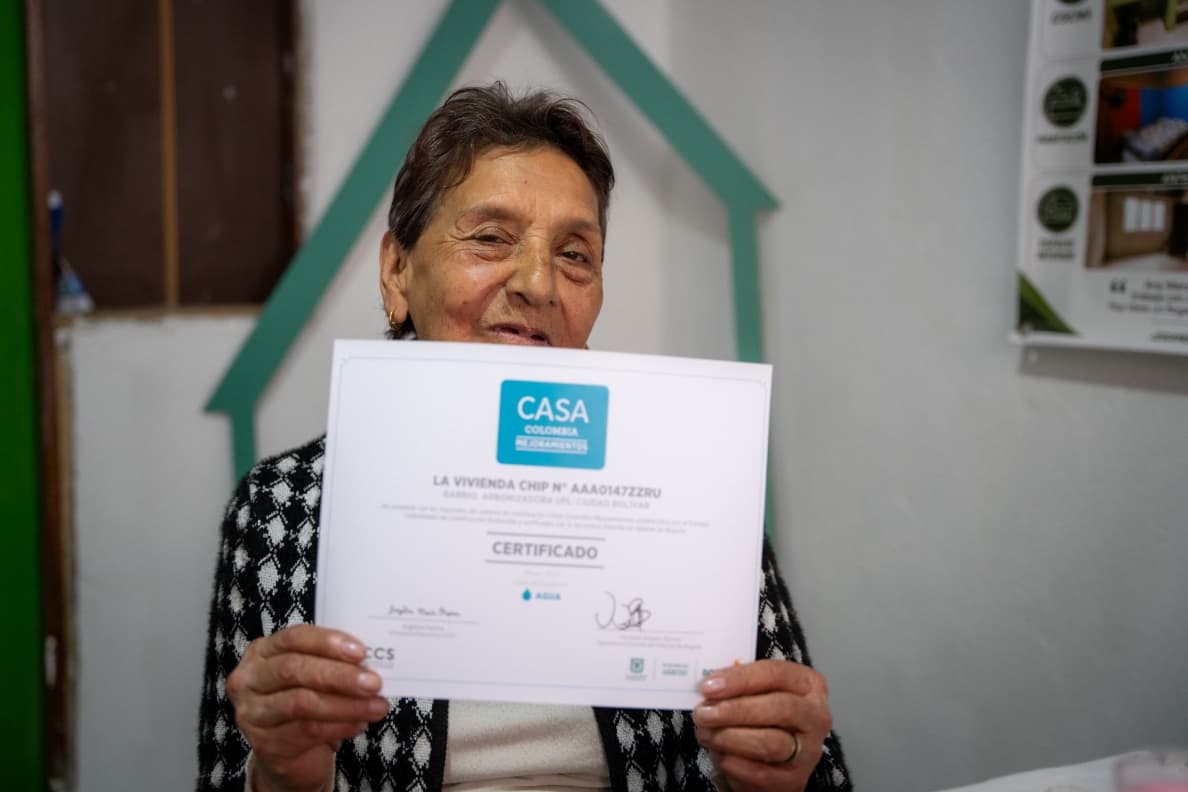
The first certified homes delivered in Bogotá demonstrate that this model can become a reality in individual households and neighborhood-scale interventions. They also show that sustainability can be integrated into social programs through measurable criteria and verifiable results, without creating any financial burden for the families benefiting from these improvements.
Colombia is demonstrating that home improvement can simultaneously serve as a strategy for urban sustainability and social equity. The challenge now — and the work the Colombia GBC will continue to advance — is to scale these types of models by bringing in new partners, supporting more cities, and strengthening the capacity to measure and verify results. The goal is for what is today a pioneering experience to become a replicable standard across the region.